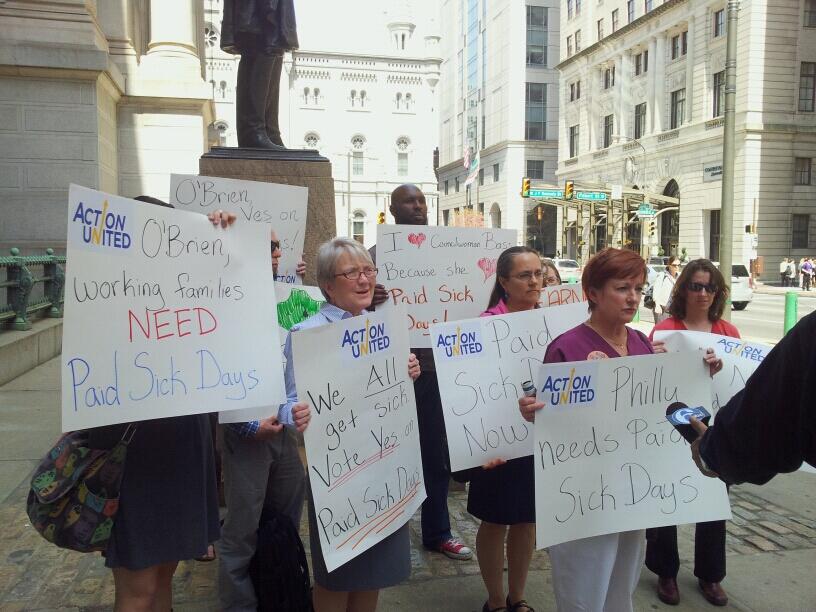
Showing posts with label economic security. Show all posts

Monday, July 27, 2015

필라델피아시에서 병가가 법적인 효력을 갖게되었습니다! (Philadelphia's Earned Sick Days law is now in effect - Korean)

http://bit.ly/2iW107h
http://bit.ly/2ibQWZj
필라델피아시에서 일년에 40시간 이상 일 할 경우 유급 또는 무급 병가를 자신이나 가족을 위해 받을 수 있습니다. 또한 법적으로 직장상사가 병가를 받을 권리를 거부할 수 없습니다.


자세한 내용은 엡사이트를 확인하시길 바랍니다.


병가에 대한 권리 보장은 대단한 발전이며 이를 통해 가족을 위해 직장을 보장받고 또 열심히 일함으로 경제발전에 기여하며 도시를 부흥시키는 계기가 될 것 입니다.

다른  도시에서도 이런 비슷한 법을 통과시켰을 때 많은 일자리가 생겨났습니다. 그래서 필라델피아의 경제 성장에도 기여 할거라 확신하며 우리의 사업에도 많은 유익을 줄 거라 믿습니다.


주변의 친구들에게 이 새로운 권리를 트위터나 페이스북을 통해 많이 알려주길 부탁드립니다.

www.phillyearnedsickdays.com
Facebook: PhillyPaidSickDays
Twitter: @EarnedSickTime

https://drive.google.com/open?id=0B71cGLXVNdI9T2FQN3JHMEdpajQ


Thursday, July 2, 2015

Earned Sick Days At Work: Passing the 10 MILLION Mark!

US Navy 050114-N-3659B-050 he Morale Welfare and Recreation Child Development Center on board Naval Support Activity Mid-South in Millington, Tenn., provides daycare servicesJuly 1 marked the day that Massachusetts and California implemented the earned sick days bills that were passed in each state last year. These new bills, along with one passed in Oregon and another in Montgomery County, Maryland, brings the total number of locations with earned sick days to 24! That's 24 states, counties and cities that allow their workers to take care of themselves or a loved one without having to sacrifice income or employment.

And just how many people are now covered, you ask? More than 10,400,000 workers now have access to earned sick days nationwide.

The national effort to secure rights for workers and their families have ensured a higher standard of living for many men, women, and children. But our job is far from over! As special interest groups and lawmakers attempt to stop our progress or even take back gained provisions, please continue to support earned sick days and your communities.

Interested in PathWays PA blog posts on similar topics?

Tuesday, April 9, 2013

Press Release: Pressure Mounting on City Council to Side with Families, Override Mayoral Veto of Sick Days

FOR IMMEDIATE RELEASE: Tuesday, April 9, 2013
CONTACT: Emma Stieglitz, emmaS@berlinrosen.com, (646) 200-5307
Jonathan Lipman, Lipman@berlinrosen.com, (773) 580-1603

NURSES RALLY FOR EARNED SICK DAYS AS NEW POLL SHOWS OVERWHELMING SUPPORT AMONG PHILLY VOTERS

Pressure Mounting on City Council to Side with Families, Override Mayoral Veto of Sick Days

PHILADELPHIA—As nurses and childcare professionals rallied at City Hall to urge City Council to side with Philadelphia families and override Mayor Nutter’s veto of the Earned Sick Days bill, a new poll was released today showing overwhelming support for the measure among Philadelphia voters.

The earned sick days bill would protect nearly 200,000 Philadelphians who are currently unable to earn paid sick days, preventing them from taking time off when they or their families are ill. The bill passed Philadelphia City Council 11-6, but was vetoed by Mayor Nutter. Supporters are pressing for Council to override that veto on Thursday.

The new survey of 590 Philadelphia voters from Public Policy Polling shows a strong 77 percent of Philadelphia voters supporting a law requiring businesses to allow earned sick time. In addition, 68 percent support an override of the mayor’s veto, and a plurality of voters say that a council member’s failure to override the veto would make them less likely to vote for that council member.

Support for sick days was particularly strong among growing parts of Philadelphia’s electorate:
• 84% of women strongly support a law guaranteeing earned sick days and a whopping 95% support it overall;
• 73% of independent voters support the law.
• 93% of Hispanic voters in Philadelphia strongly support the law, with only 1 percent voicing any opposition.

“This polling tells us what we already knew to be true, that Philadelphians support, want and need earned sick days,” said Marianne Bellesorte, senior director of policy at Pathways PA and a leader of The Coalition for Healthy Families and Workplaces, which supports the bill. “We urge the City Council to listen to their constituents, not to corporate lobbyists, and side with families by overriding the Mayor’s veto on earned sick days.”

Nurses and caregivers today told council how especially crucial earned sick days are for working parents, who without paid sick days can face the terrible dilemma of choosing between caring for a sick child or earning the money needed to pay for that child’s needs.

“Being able to earn paid sick days is a basic protection for working families,” said Patricia Eakin, PASNAP President and an Emergency Room Nurse at Temple University Hospital. “Parents should be able to take a few hours off work to take their kids to a doctor during the day; otherwise a child’s sickness could worsen and result in a trip to the ER. A job should be what enables you to care for and support your family, not what prevents you from caring for them.”

Research shows that families without access to sick days are also the ones least able to afford unpaid time off. The issue is compounded for working parents who are often forced to send sick children to school because they cannot afford to take care of sick children at home. Studies have shown that parents with earned sick days are 20 percent less likely to send a sick child to school and that when parents care for sick children at home, they get better sooner and reduce the risk spreading the illness to their classmates. A new study from the Institute for Women’s Policy Research (IWPR) shows that sick days would save Philadelphia an estimated $10.3 million a year in healthcare costs by reducing preventable emergency room visits.

Lawmakers and business leaders around the country are supporting earned sick time as a policy that strengthens the economy by keeping people in their jobs. This March, Portland, OR became the fourth city to adopt paid sick days, and New York City is poised to become the 5th US city, and the largest city yet, to pass a paid sick days law. Statewide bills are moving forward in Vermont and Massachusetts. Residents of Orange County, FL, should be able to vote for sick days in August 2014 thanks to 50,000 voters who petitioned for the ballot initiative.

These recent wins and active campaigns build on past victories in Connecticut, which passed the first statewide law in 2011, Seattle in 2011, Washington DC in 2008, San Francisco in 2006, and a November 2012 ballot initiative in Long Beach, California granting sick days to hotel workers. At the federal level, Rep. Rosa DeLauro and Sen. Tom Harkin introduced the Healthy Families Act this month, which would set a national sick days standard.

###

Friday, April 5, 2013

It's Up To Council - And You - To Make Earned Sick Days Happen

After years of work on earned sick days in Philadelphia, it all comes down to one vote.

On April 11, City Council will vote to override Mayor Nutter's short-sighted veto of earned sick days.

12 Councilmembers must vote to override the veto. 11 Councilmembers voted in favor of the bill.

Will you join the community of Philadelphians who are asking City Council to take the lead in supporting working families?


Here is an example of what you can say:

"Hi, my name is [NAME].

I live/work in Philadelphia, and as a constituent, I am calling to tell the Councilman that I support earned sick days for all Philadelphia workers and to ask him to overturn the Mayor's veto.

Paid sick days are about justice. Families need to know that one flu won't cost them their jobs or their financial security." If you have a personal story about earned sick days, share it with the staffer. You can also ask the person who answers the phone if the Councilman plans to vote to override the veto. After your call, please report back on how it went!


Why earned sick days? Because working without sick days places families in an impossible situation.

Small businesses suffer without earned sick days because of reduced productivity and the expense of high turnover.

Consumers and coworkers suffer without earned sick days when they are exposed to sickness.

And of course, the workers themselves suffer. After all, every day without sick days is a day we are asking them to choose between the jobs they need and the families they love.

It is clear that the leadership that our city needs on this issue will not come from the Mayor's office. It is now up to Council to enact the will of the overwhelming majority of Philadelphians by overriding this veto to make earned sick days law.

Please take a moment right now to ask them to do just that.

Monday, March 26, 2012

Why Are Earned Sick Days Important? Ask Betty Carr.

Poems of the Sea, 1850 - The Sailor's Sick ChildFrom the Reading Eagle:
Betty Carr had to move herself and her children out of their home after suffering physical abuse from her boyfriend.

Then her 8-month-old son got sick, and Carr had to stay home with him.

So Carr lost her job in food service because her employer believed she took too much time off to care for her son.

That put the 28-year-old and her two children in a Berks Women in Crisis shelter temporarily.

To read more about Betty's story and the issues that many single mothers face, please visit http://readingeagle.com/article.aspx?id=375295.

Tuesday, November 8, 2011

Young Adults Struggle with Lack of Paid Sick Days

During the health reform debate there was a lot of talk about the need for young adults to have access to their parent’s insurance because many found insurance too expensive and went without. Because illness can strike anyone, even the young, Congress extended the age that a child can be on their parent’s insurance until 26.

While this is a great accomplishment, if young adults cannot use their insurance because they cannot take off of work to see a doctor or get the care they need, then they will still find themselves facing chronic issues that could have been easily treated or resorting to the emergency room for non-emergencies.

A new report, The State of Young America, shows that young adults have little access to paid time away from work to use to recover from illness and care for a sick family member. A survey of young adults, ages 18 to 34, shows that fewer than 3 in 10 reported having paid sick days they can use for themselves, a child, and an immediate family member. Fewer than 1 in 4 women and fewer than 1 in 6 Latinos said they have this basic right.

Young Americans face very tough times ahead. Unemployment and underemployment are rising, the cost of living and student debt are increasing, and wages are declining. Missing even just one day of work can mean the difference between paying bills and putting food on the table.

Worker and family friendly policies like paid sick days are necessary for the economic security of all Americans because no matter someone’s age, everyone can get sick and everyone deserves the time to get better.

Tuesday, July 26, 2011

Economic Security and Paid Sick Days

From EPI's "The Need for Paid Sick Days"
If you read this blog often, you know the basics on the need for paid sick days:
  • 40 million private sector workers nationally have no access to paid sick days (and over 200,000 here in Philadelphia are in the same boat)
  • Employees without paid sick days are more likely to work sick, reducing their productivity at a cost to their employers and themselves
  • Parents without paid sick days are more likely to send children to school while ill, which not only hurts the child in the short-term but also poses risks to long-term health and development
However, a new report from the Economic Policy Institute points out some additional items about economic security and paid sick days that you might not have known.  This report uses a common approach to determining what a family needs to make ends meet: 200% of the Federal Poverty Level, or almost $45,000 for a family of four (although research shows families may need even more).

A two-parent, two child household, with both parents working and earning $10/hour, already earns below 200% of the FPL.  This household needs to earn $3,639 to make ends meet, but only earns $3,470, even without taking an unpaid sick day. One parent using 3.5 days of unpaid sick time in a month (which could happen easily if just one child got sick) would lose the income equivalent to the family's grocery budget for the entire month.

Single parent households earning $10/hour and caring for two children also earn well below what they need to be economically secure: just $1,735 per month, compared to the $2,891 per month economic security threshold.  Missing more than three days of work in a month for this family would put it below the Federal Poverty Level.

As cities, states, and the Federal Government continue to look at the issue of paid sick days, these numbers should be taken into account.  Until we have developed a foolproof way to avoid getting sick, we need to make sure that all families can afford getting sick.

Thursday, June 30, 2011

The Mayor's Statement on Sick Days

On Tuesday, Mayor Nutter released a statement giving his reasons for vetoing Bill 080474, Promoting Healthy Families and Workplaces, which would have allowed all Philadelphians to earn sick days in their jobs.  However, the Mayor's statement does not take all of the recent research and information into account.
  • The Mayor states that "the imposition of this requirement on Philadelphia alone -and not on a statewide or national basis - would simply create too great a burden on our local businesses, would render us uncompetitive in the global marketplace and would cost Philadelphians jobs."
    • Since 2007, when San Francisco’s law took effect, job growth has been consistently higher in the city than in neighboring counties that lack a paid sick days law. Total employment in San Francisco increased 3.5 percent between 2006 and 2010, while employment in its five neighboring counties fell by 3.4 percent overall.
    • The Philadelphia smoking ban, which was supported by then-Councilman Nutter, is one of many bills that faced the same criticisms of needing to be done at a state or federal level to avoid burdening businesses.  Yet when the smoking ban passed, it paved the way for a similar bill at the state level, similar to what passage of paid sick days at the local level can do for the state.
    • Since most other countries offer paid sick days (at least 145), offering the opportunity to earn paid sick days in Philadelphia could not make us uncompetitive in the global marketplace.
  • The Mayor also states that "Mandating employers to provide sick leave benefits to employees raises the cost of labor for businesses that do not already provide such benefits.  Moreover, the bill imposes considerable administrative burdens on businesses, particularly small businesses that do not have sophisticated time-keeping systems in place."
    • Data from San Francisco shows that 6 out of 7 businesses reported no negative effects on profitability as a result of passing a more comprehensive sick days bill than that passed in Philadelphia. 
    • Even without sophisticated time systems, all businesses must be able to report wages and hours in addition to calculating federal, state, and local taxes, not to mention payroll taxes.  Under the bill, workers would earn 1 hour of sick time for every 40 hours worked, which comes out to 0.025 hours of sick time earned per hour work.  This would not be a difficult formula to add to an employer's financial management system, spreadsheet, and/or list of calculations.
  • In his statement, the Mayor cites an analysis from Dr. William Dunkelberg, which concludes that paid sick days "would cost businesses in Philadelphia hundreds of millions of dollars annually."
    • Lonnie Golden and Stephen Herzenberg released a report in May 2012 showing many errors in the Dunkelberg study, including a doublecounting error, implausible assumptions, and questionable methodology.
  • The Mayor also states that the bill "fails to exempt businesses that already provide the mandated number of paid sick days from complying with other aspects of the bill."
    • The bill clearly states that businesses who provide an equal or greater amount of sick time, vacation time, personal time, PTO, etc., do not have to change their policies so long as people can take the time when needed (i.e. without advance notice).
    • However, the bill does state that employers cannot retaliate against workers for taking sick days (although they reserve the right to take action if an employee is misusing their time).  The exemption the Mayor is looking for, also known as the "Wal-Mart exemption," would allow businesses to offer sick days but to penalize employees for using it.  An estimated 128,000 workers in Philadelphia already face such retaliation even though they have sick days - one of the aims of this bill is to protect workers from such retaliation.

Wednesday, June 1, 2011

Daily News Op-Ed: The Benefits of Paid Sick Days

LAST WEEK, a group of economists, including the authors of this op-ed, published an open letter to City Council urging passage of a bill that would let every worker in Philadelphia earn paid sick days. A growing body of real-world research shows that the Promoting Healthy Businesses and Workplaces bill would be good for business, good for the economy and good for public health.

The public seems to agree. A poll released last week indicates that seven in 10 city voters support such legislation.

For many workers, taking a day off from work to care for themselves or their kids when illness strikes means losing a day's pay, or worse - losing their jobs. The alternative is sick adults going to work or sick children going to child care or school. People should not be forced to choose between being a good worker and being a good parent.

To read the full article by Lonnie Golden and Steve Herzenberg, please visit The Daily News website.

Wednesday, May 25, 2011

MomsRising Paid Sick Days Blog Carnival

Thank you to MomsRising who put together a Blog Carnival focusing on the need for paid sick days in Philadelphia. Some of the authors include Coalition partners, national experts, and moms. See a list of the blog posts below.

An Apple A Day Isn’t Enough: Blog-A-Thon For Philadelphia’s Earned Sick Days Law, by Ruth Martin, MomsRising. “Planning, preparation, prevention – it all comes with the territory of being a mom. We try to head off as many accidents and illnesses as we can; we child-proof, we carry hand sanitizer, and we teach our kids to wash their hands. But there is a big hole in our safety net: Two out of five – that’s 41% – of Philadelphia employees are not allowed by their employers to earn even a single paid sick day to care for their own health and thousands more are unable to take a paid day to care for a sick child or parent.”

In the City of Brotherly and Sisterly Love, A Chance to Stand Up For Working Families, by Vicki Shabo, National Partnership for Women and Families. “With more than 210,000 working people in Philadelphia lacking access to paid sick days, approving a law to establish a standard should be common sense for the City Council.”

Bad Economics Meet Paid Sick Days in Philadelphia, by Robert Drago, Institute for Women’s Policy Research. “A new study for the National Federation of Independent Businesses (NFIB) estimates that Philadelphia’s proposed paid sick days legislation would cost employers between $350 million and $752 million annually. Both the factual basis and the assumptions underlying this study are seriously flawed.”

Support Paid Sick Days In Philadelphia! by Angie Norris, Studio 34 Yoga. A Philadelphia nurse who’s also a small business owner shares her perspective on providing paid sick days. Thank you to Angie for providing earned sick time!

In Philadelphia, A Healthy Workforce and a Healthy Business Environment Go Together, by Amy Traub, Demos. “In an era of high unemployment, good policymaking also requires that we answer another question: how would guaranteeing all working people in Philadelphia the right to earn paid sick leave impact the city’s economy?”

Philadelphians deserve right to time off when sick, by Kathy Black, president of the Coalition of Labor Union Women, Philadelphia chapter. “Paid sick days is a policy that’s good for workers, good for families and good for our community. And businesses in other cities that have a paid sick day law say the law has no negative impact on profitability – by a measure of 6 to 1!”

Apocalypse Never: Earned Sick Days Provide Benefit, Not Doom, by Jake Blumgart. “Rather than just making fretful predictions, we should look at empirical evidence gathered from successfully implemented paid sick leave bills.”

This boss doesn’t mind paid sick days, by Dewetta Logan. The owner of a small childcare center in West Philly shares her experience in providing earned sick time. And– BIG thank you to Dewetta for protecting your employees and the kids you all care for by providing earned sick time!

Economists say paid sick days will help Philadelphia make progress toward economic recovery, by Marianne Bellesorte

Letter to the Editor: Workers Need the Opportunity to Earn Sick Days, by Diane Mohney. Certified school nurse offers her 29 years of wisdom and experience in explaining the need for sick days. Scroll all the way to the end to check it out.

Faith leaders sign letter in support of earned sick days in Philadelphia, by Kate Scully. Faith leaders sign a letter to Mayor Nutter in support of providing all workers in Philadelphia with the opportunity to earn paid sick days.

Philadelphia Business Journal: Sick Days for Healthy Recovery, by Eileen Appelbaum and Lonnie Golden. “Mandating paid sick days is one policy that will help employers keep workers in jobs.” Subscribers can read the entire article.

Every Parent wants to protect their children, by Barbara Lovelace of north Philadelphia. Barbara shares the agonizing decision her daughter had to make: Stay by Barbara’s side as she lay in the hospital’s Intensive Care Unit, or return to her job as a cashier worrying about whether her mother would pass away while she was on the job.

Status Update: I support paid sick days!, by Marianne Bellesorte. If you can’t make it to City Hall, join our virtual Facebook rally to support earned sick time in Philly!

Support Paid Sick Days For Philadelphia Families, by Jennifer at PhillyFun4Kids.We take a moment out of bringing you Philly’s best family friendly free or mostly free fun to think about this…In Philadelphia over 40% of workers do not have the ability to earn any paid sick days.

Mothers Gather at Childspace to Support Earned Sick Days, by Zach Subar. Power of one(sies) decorated with messages like “Moms rock!” also tell the story of why paid sick days are a family friendly policy.

Using NFIB Economist’s Estimates on Paid Sick Days: It’s Not Cricket, by Steve Herzenberg.  Herzenberg shows that even if readers oppose paid sick days, they shouldn’t use the Dunkelberg estimates because, well, “It’s not cricket.” The estimates are so transparently inflated that folks who live in a fact-based world shouldn’t use them.

Philadelphia Paid Sick Days Law Would Allow Workers to Take Care of Their Chronic Conditions, by Andrea Lindemann.  In Philadelphia, there’s a disconnect between public health initiatives and access to care. The reason? Lack of paid time off to get to the doctor to care for chronic conditions. 

It’s time now for workers to be able to earn paid sick days in Philly and across the country, by Linda Meric.   Millions of Americans working without paid sick days face the impossible choice between caring for their health and that of their family, and keeping their paycheck or job. At a time when many families are worried about their financial security, the threat of losing a job or needed wages forces many workers to go to work even though they are ill.

Rooting for Passage of Paid Sick Days in Philadelphia, by Ellen Bravo.  Every night a second grade teacher washes the top cover of her reading couch because some child has had to come to class with the flu rather than staying home alone.

Thursday, April 28, 2011

Advisory: A Conversation with Philadelphia Public School Nurses TODAY 4/28

Sleeping students
Contact: Lauren Townsend 215-939-7621
Coalition for Healthy Families and Workplaces

A Conversation with Philadelphia Public School Nurses
TODAY 4/28
Nurses will share their experiences and talk about sick children coming to school when they should really be home getting well.

"Having been a school nurse for 29 years in the Philadelphia Public School System, I witnessed time and time again children who came to school sick because their parents had to work and couldn’t afford to take the day off to spend time helping their kids get better. Asthmatic children who came to school wheezing sometimes had to be sent to the emergency room by ambulance. Children with red, watery eyes frequently turned out to have pink eye. A student who just “looked tired” at home turned out to have a high fever with a strep throat. And a child who had a stomachache and vomited the night before turned out to have pneumonia. All of these children should have been taken to the doctor, but their working parents would have lost a day’s pay." Diane Mohney, RN.

WHAT:
Philadelphia Public School nurses (RNs) will talk about their experiences and talk about sick children coming to school when they should really be home getting well. The nurses support the Promoting Healthy Families and Workplaces Act (Bill 080474) is a bill that would allow Philadelphia workers the opportunity to earn up to seven days of sick time per year.

WHO:
Registered Nurses (RNs) working in the Public Schools will include: Diane Mohney, Francesca Hoeffel, Gwen Robbins and Lynette Lazarus.

WHEN:
4:30 PM - Thursday, April 28, 2011

WHERE:
Melrose Diner 1501 Snyder Ave, Philadelphia, 19145
* (we will be sitting at a table and will be on the look-out for members of the press)

RSVP:
Because we are meeting at the Melrose Diner, we would like RSVPs from the press. Please email/call Lauren Townsend at ltownsend4@gmail.com or 215-939-7621 and let Lauren know that you would like to join this important conversation with school nurses. Put "School Nurses" in the subject line.

Background:
Promoting Healthy Families and Workplaces Act (Bill 080474) is a bill that would allow Philadelphia workers the opportunity to earn up to nine days of sick time per year. It was voted out of the Public Health and Human Services Committee on March 1, 2011. The bill could affect up to 200,000 workers in Philadelphia who do not have access to paid sick days.

With over 40 percent of Philadelphians lacking earned sick days, a large portion of the population cannot take the time off work to go see a doctor or obtain medical treatment - regardless of the medical coverage they have.

Employees with earned sick days are more likely to stay home when they are sick, limiting the spread of the illness and protecting co-workers, customers, or anyone else they meet during the work day. During the height of the H1N1 pandemic, people were urged to stay home if they had any signs of the flu, however, those without earned sick days were less likely to stay home because they could not afford to. As a result, nearly 8 million H1N1 cases were traced back to employees going to work while sick.

Thursday, November 4, 2010

Profitability and Workplace Flexibility Can Go Hand in Hand, Even for Small Businesses

Earned sick time is often considered a "worker-friendly" policy.  Unfortunately, in some circles, "worker-friendly" is synonymous with "anti-business."  However, as many businesses across the country have pointed out, sick employees do not make for high productivity or good business practices. 

In a recent article on TheHill.com's Congress Blog, two small business owners point out that "we want workers to stay home when they’re sick and not infect others – and they can’t if the time isn’t paid, or if taking off routinely results in discipline."  They point to the need for national minimum standards "akin to the minimum wage – we exceed the basement to get a competitive advantage in attracting great employees, and our competitors can’t undercut that with bad employment practices."

Earned sick time is one of many minimum standards that can benefit workers, businesses, and the economy.   Since an earned sick time bill became law in San Francisco in 2007, both the San Francisco Chamber of Commerce and the Golden Gate Restaurant Association have said that earned sick time had not caused undue hardships for members.  The Executive Director of the Restaurant Association has gone so far as to say "paid sick days 'is the best public policy for the least cost.'"

As we continue to examine the need for earned sick time, we need to hear from more businesses such as the two who wrote TheHill.com's blog post.  Just recently, we heard from the Health Federation of Philadelphia, who believes earned sick time "keeps us competitive as an employer, contributes to employee loyalty and, thereby cuts down on turn-over."

If your business provides earned sick time, please let us know, and help to show that worker-friendly policies are also business-friendly, even in today's economy.

image courtesy of http://www.flickr.com/photos/scelera/2243429936/in/photostream/ // http://creativecommons.org/licenses/by-nd/2.0/

Monday, September 20, 2010

Listen to Last Week's Radio SmartTalk to Learn More About Earned Sick Time

On September 13 last week, Representative Marc Gergely and Gene Barr from the PA Chamber of Business and Industry spoke for an hour about earned sick time in Pennsylvania.  As you may remember, this discussion was postponed last month because Rep. Gergely needed to take a sick day in order to meet with a surgeon about his son's recently broken foot.

You can listen to Representative Gergely and Mr. Barr and leave your own comments at the Radio SmartTalk page.  You can also download the podcast through iTunes for free.

image courtesy of http://en.wikipedia.org/wiki/File:Fisher_500_radio.jpg

PCN Video on Need for Earned Sick Time

A new video on the need for earned sick time is now available.  PCN's monthly television program "Agenda for Action" included a story on HB 1830 and an interview from Tiffany Lomax about her need for earned sick time.  You can watch it on YouTube or view it below.

Tuesday, September 14, 2010

Watch PCN on September 26 to Learn More About Earned Sick Time!

On Sunday, September 12, PCN's monthly television program "Agenda for Action" included a story on HB 1830, including a story from Tiffany Lomax about her need for earned sick time.

The "Agenda for Action" program features discussions on state issues with members of the House Democratic Caucus. It also highlights specific legislation and initiatives through reports and stories showcasing people across Pennsylvania. This program will be rebroadcast on September 26 at 2:30 PM.  A preview can be seen on the Agenda for Action website.

Tuesday, August 24, 2010

Op-Ed in Patriot News on the Need for Earned Sick Time

"Paid sick days legislation makes sense for all businesses"

by Carol Goertzel, President/CEO of PathWays PA

When Tiffany Lomax hears her son’s breath get shorter, she knows what is coming next.

Her chest constricts in sympathy with him as he begins to cough and wheeze, and together they fight for control over his asthma. But Tiffany can now care for her son with a little more peace of mind. She knows that, if needed, she can get him to the doctor or hospital without risking her job — all because she earns paid sick days. 

To read the whole story, please visit the Patriot-News website, and be sure to add your comments to the discussion!

Monday, August 16, 2010

Press Conference 8/17/10 at 12 PM in Capitol Rotunda: One Size Doesn’t Fit All When it Comes to Sick Days However, No One Should Have to Live with Extra Small

In Pennsylvania, approximately 46% of all workers do not have access to earned sick days.

HARRISBURG— On August 17, the House’s Labor Relations Committee will hold a hearing to discuss the Healthy Families, Healthy Workplaces Act (HB 1830), which gives Pennsylvania’s workers the opportunity to earn up to 6.5 days (52 hours) of paid sick time. Workers would be permitted to use the hours they earn to care for themselves or a family member when they are sick. This bill has the support of the Coalition for Healthy Families and Workplaces, which is made up of a broad range of workers, nonprofit organizations, labor groups, and legislators.

Currently in Pennsylvania 46% of workers have no earned sick days, and a majority of employees without this benefit work in food service and care giving positions. When workers without earned sick days are sick, they have to choose between going to work – where they could potentially infect co-workers or customers – and staying home – where they will lose pay and possibly their job.

“In Pennsylvania, you shouldn’t have to risk your job to take care of your family,” said Carol Goertzel, President/CEO of PathWays PA. “We are in the 21st century, but our workplaces are operating under 19th century rules. If we believe in family values, those values should not stop at the workplace door.”

Earned sick days allows families to stay economically secure while they keep their families physically secure. The fear of job loss when workers have no access to sick days is very real. Nearly one in four workers without paid sick days (23 percent) in a recent poll has lost a job or been told they would lose it for taking time to care for a sick family member or a personal illness.

Providing earned sick days has proven to be smart for businesses as well as for workers. Research shows that the costs of replacing workers, including advertising, interviewing and training new employees, far outweighs the cost of retaining employees by offering earned sick days. Additionally, presenteeism, when workers come to work sick, costs the national economy about 180 billion a year in lost productivity versus absenteeism. Furthermore, under this bill, businesses can use the sick days, vacation days, and personal days they already offer to match up with the 6.5 days that workers earn each year. This flexibility allows employers to create the policy that best fits their business, without leaving employees struggling to fit into an “extra small.”

Speakers at tomorrow’s press conference will include:
  • Representative Marc Gergely
  • Carol Goertzel, President/CEO of PathWays PA
  • Robert Drago, Ph.D., Research Director for the Institute for Women's Policy Research
  • Kate Etherington, Senior Program Director for the Philadelphia Physicians for Social Responsibility
  • Rebecca Foley, Director of Education and Advocacy Initiatives, WOMEN'S WAY

###
PathWays PA began in 1978 as the Women's Association for Women's Alternatives, one of Pennsylvania's first residential programs to keep low-income, vulnerable women together with their children. It has grown to become one of the Greater Philadelphia region's foremost providers of residential and community-based services for women and their children. Each year PathWays PA serves more than 6000 women, children and families who reside in Philadelphia, Delaware, and Chester counties through a full complement of social services, job training and employment assistance, outreach and residential programs.

The Coalition for Healthy Families and Workplaces is a group of organizations supporting the need for earned sick days in Philadelphia and Pennsylvania. It is primarily coordinated by PathWays PA and WOMEN’S WAY. Coalition members include

Childspace CDI ▪ CLASP ▪ Coalition of Labor Union Women ▪ Institute for Women's Policy Research ▪ Maternity Care Coalition ▪ MomsRising ▪ National Partnership for Women & Families ▪ National Organization for Women (Philadelphia Chapter) ▪ PathWays PA ▪ People's Emergency Center ▪ Philadelphia Physicians for Social Responsibility ▪ Philadelphia Security Officers Union ▪ SEIU ▪ The Campaign for Working Families ▪ Women's Law Project ▪ WOMEN'S WAY ▪ Women Vote PA

Philadelphia Inquirer: A Push for Paid Sick Leave in PA and Philly

San Francisco led the way, showing that a move to help workers can also benefit employers.

By Jake Blumgart

You wake up with a throbbing headache, achy muscles, and a hacking cough. Do you miserably trudge into work or call in sick? Will the call depend on the health of your body or your wallet?

For almost half of Pennsylvania's workforce, the answer will come down to money. Neither Pennsylvania, nor any other state, requires employers to offer earned sick leave. True, 54 percent of the state's private-sector workers are offered sick-leave pay, as are 56 percent of workers in Philadelphia. But those who enjoy such benefits tend to have higher incomes, which means, perversely, that if you can swallow an unpaid sick day, you don't have to. The other half of the workforce is on its own.


For the complete article please click here.

Monday, June 21, 2010

The Time for Paid Sick Days Is Now: Survey Shows Overwhelming Public Support for a Paid Sick Days Workplace Standard

Thank you to our friends at the National Partnership for Women and Families for the information below.

A new survey conducted by the National Opinion Research Center at the University of Chicago and commissioned by the Public Welfare Foundation demonstrates that lack of access to paid sick days has significant negative consequences for public health, health care costs, and families’ financial security. The survey also shows that overwhelming majorities support paid sick days laws as a matter of basic labor policy.

The survey results could not be clearer: It is time for policymakers to guarantee access to paid sick days to the over 40 million U.S. workers who currently lack them. Workers should not have to risk their job to care for their families and shouldn’t have to risk their own-well-being—and the public’s health—to do their job.

Key Findings on Health and Economic Security

Lack of Access to Paid Sick Days Impacts Public Health
  • More than half of all workers without paid sick days (55%) have gone to work sick. And workers without paid sick days are nearly twice as likely as those with paid sick days to say they have sent their child to school or daycare sick. As the 2009 H1N1 pandemic most recently showed, going to work or school while sick increases the likelihood of spreading infection and creates significant public health risks.
Lack of Access to Paid Sick Days Drives Up Health Care Costs
  • Workers without access to paid sick days are twice as likely as those with access to say they have gone to the emergency room to get care for themselves because they were unable to take time off of work to get medical care. Workers without paid sick days are two-and-a-half times as likely to say they have taken a child or other family member to the emergency room because they were unable to take time off of work. Unnecessary ER visits mean additional burdens on our health care system and cost billions of dollars per year.
Lack of Access to Paid Sick Days Jeopardizes Workers’ Economic Security
  • Workers face job loss and workplace discipline for taking sick time. Nearly one quarter of workers (23%) say they have lost a job or were told they would lose a job for taking time off to deal with a personal or family illness, including nearly one-sixth (16%) who say they have actually lost a job. Nearly one-sixth (16%) also say they or a family member were fired, suspended, written up or otherwise penalized or were told they would face such penalties for illness-related absences.
Key Findings about Public Attitudes

Public Support for a Paid Sick Days Law Is Broad and Runs Deep 

Across demographic and political backgrounds, the public overwhelmingly supports a law that would guarantee paid sick days to all workers. Fully three-quarters (75%) favor a law providing a “minimum number” of paid sick days for all workers. Eighty-six percent favor a specific proposal that requires 7 paid sick days annually for full-time employees, including 69% who strongly favor providing workers with 7 paid sick days.
  • Eighty-five percent of seniors and 82% of retirees—a group that is particularly likely to need care—favor a law providing a minimum number of paid sick days.
  • Women (88%), African-Americans (90%), and unmarried parents (85%)—precisely those with lower access rates and more caregiving responsibilities—are particularly strong supporters.
The Public Views Paid Sick Days as a Worker’s Right
  • Three-quarters of respondents agree that paid sick days is a basic worker’s right, just like being paid a decent wage. Seven in ten (69%) say paid sick days are a very important standard to protect workers’ rights—the same share as believe minimum wage and overtime laws are very important.

For more information about the work the National Partnership for Women and Families on paid sick days please visit www.paidsickdays.org.
Advisory/Press Release (40) autism (2) behind the kitchen door (1) BKD (2) business (40) campaign (2) cdc (1) Center for Social Policy (1) center of american progress (2) child care (1) children (18) city (1) city council (8) Coalition (81) costs (11) coverage (2) COVID-19 (1) data (2) domestic violence (8) earned sick time (25) economic opportunity institute (2) economic security (27) elder (5) election (2) election day (1) equal pay (8) event (47) fair workweek (1) family (33) Family Act (5) family leave (12) fda (1) Federal Poverty level (1) flu (7) fmla (4) food safety (1) food safety modernization act (1) gender gap (2) H1N1 (7) health (4) health care (16) Healthy Families Act (21) huffington post (2) huffpo (2) implementation (5) injury (1) institute for women's policy research (2) insurance (1) law (3) legislation (46) legislators (1) legislature (1) letter to editor (7) letter writing (6) LGBT (4) living wage (4) living wage bill (8) low wage (5) maternity care coalition (1) May 13 (1) mayor (17) minimum wage (2) mobilize (1) national (11) new hampshire university (1) New York City (1) Newsletter (3) Nutter (2) NutterWatch (9) occupational injury (1) op-ed (7) other states/cities (23) PA (39) paid (1) paid leave (31) paid sick days (37) Pennsylvania (5) petition (12) PFMLI (1) Philadelphia (153) Philly ROC (4) pictures (5) Pitt (1) pittsburgh (1) polling (2) poverty (2) preemption (6) pregnancy (5) press (34) prevention (1) public comment (5) public health (31) ranking (1) regulations (2) report (15) restaurant workers (3) restaurants (10) ROC (1) safe time (1) san francisco (17) SB 333 (1) Seattle (1) Shriver Center (1) sign-on (1) SPM (1) stats (10) Story (23) study (4) Supplmental Poverty measure (1) take action (40) tax credits (1) transportation (1) trust across america (1) university of Boston (1) university of Michigan (1) University of Pittsburgh (1) veto (1) video (3) Virginia (1) volunteer (1) vote (6) vote for homes (1) voter id (1) Washington DC (1) women (16) work flexibility (1) work-life balance (14) workers (3) world economic forum (1)